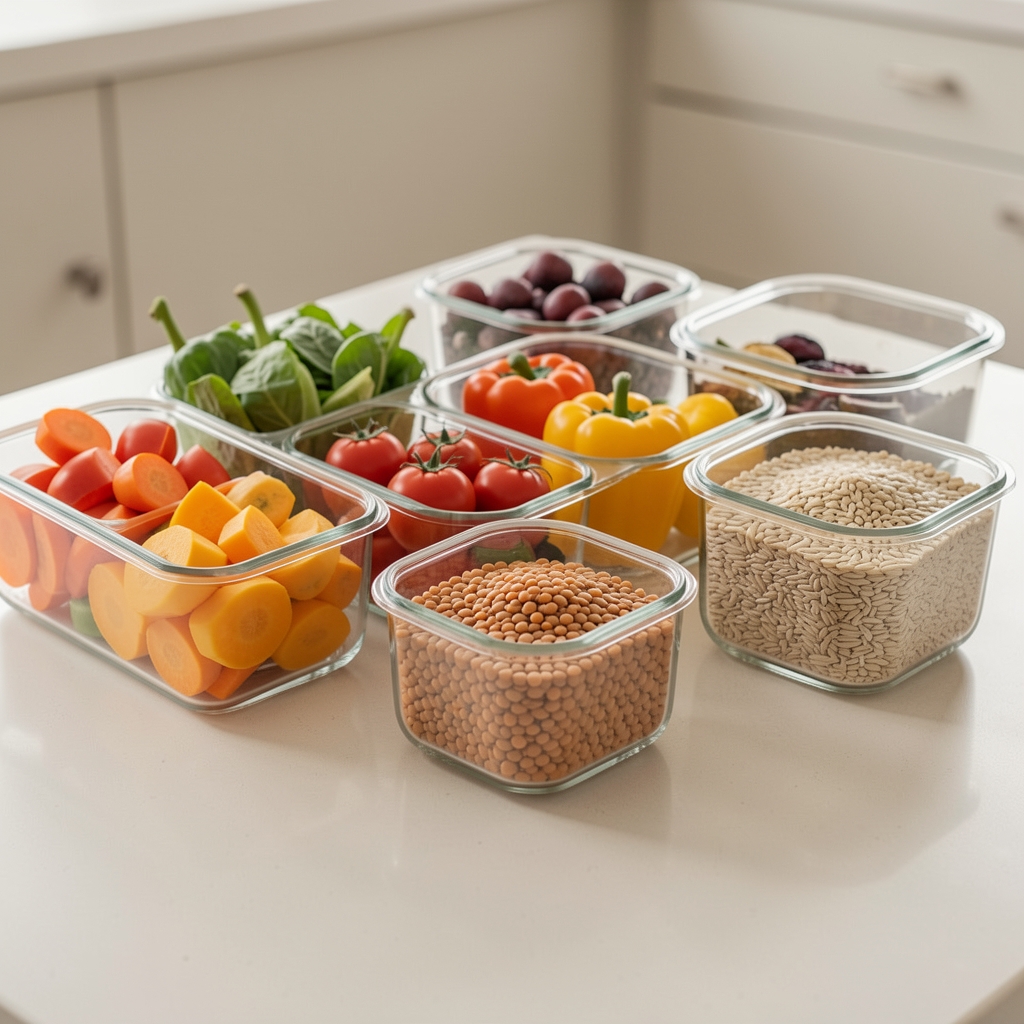
London, April 2026 — The notebook runs to four volumes across twelve months. Each entry records the same information: what was served, in what approximate quantity, what remained after eating, and a brief note on appetite at the time of the meal. The project was not designed to achieve anything. It was designed to observe. What those four volumes contain is the closest thing this writer has produced to an honest account of how eating actually proceeds across a year of ordinary life.
The Starting Premise: Observation Without Target
The project began in April of the preceding year with a single methodological commitment: no targets would be set. No calorie thresholds, no weight benchmarks, no portion sizes structured from any external source. The notebook would record only what was present on the plate and what was consumed from it. The analysis, if it came, would come afterwards — from the accumulated data, not from an advance hypothesis.
This approach runs contrary to the dominant register of nutritional self-management, which tends to begin with a goal and work backwards toward the behaviours required to achieve it. The goal-first approach is not without merit — there is substantial research from behavioural science supporting the utility of specific, measurable targets in the formation of new habits. But it carries a known liability: when targets are not met, the gap between intention and performance often produces what researchers in the field have described as a motivational collapse, in which the perceived failure of a single day or week undermines the longer-term practice.
The observation-first approach carries a different risk: that without a target, there is no structure, and without structure, the notebook becomes simply a food diary without analytical utility. The answer, discovered gradually across the first two months of the project, is that the structure emerges from the data itself. Patterns become visible after sufficient entries. Recurring divergences from an instinctive sense of the appropriate become legible in the record. The notebook, sustained long enough, generates its own reference points.

Months One Through Three: The Accumulation Effect
The first three months of entries reveal a pattern that the writer had not anticipated: the baseline serving sizes, as recorded without any prior adjustment, are substantially larger for grain-based foods than for vegetables and proteins. On a typical weekday evening, the grain component — usually pasta, rice, or bread — occupies roughly half the plate by visual volume. Vegetables occupy perhaps a third. The remaining fraction is divided between a protein element and, on several evenings per week, a further grain-adjacent addition: garlic bread alongside pasta, or crackers served with soup.
This is not unusual. Population-level dietary surveys across Western Europe consistently report that grain and refined carbohydrate foods constitute the dominant volumetric component of the average evening meal, with vegetables in a secondary supporting role. The observation is not a judgment — it is a data point. What the notebook allows is a comparison across the weeks: whether this ratio changes, remains stable, or drifts further in either direction as the months accumulate.
By the end of month three, with the first volume of the notebook complete, a secondary observation has emerged alongside the compositional one: the evenings on which the vegetable component is largest — not as a result of deliberate planning, but as a function of what was available and what seemed appealing — are also the evenings on which the recorded appetite note most frequently reads "satisfied without fullness." The phrase recurs. It is not analytical language; it is the description of a physical state. Its frequency in association with vegetable-dominant plates is the first data point that the notebook itself generates, independent of any external reference.
"The notebook does not tell you what to eat. It shows you what you have eaten, and — over time — what that pattern has looked like. The observation is the intervention."
The Mid-Year Recalibration
The transition from spring to summer in the second volume of the notebook marks a natural recalibration point. The seasonal shift in available produce — away from the dense, starchy roots of winter and toward the lighter, higher-water-content vegetables of summer — produces a corresponding shift in the recorded compositions. Summer meals are lighter, more varied in their plant diversity, and more frequently composed of foods consumed with minimal preparation: salads, lightly dressed raw vegetables, cold grain dishes assembled from components prepared earlier in the week.
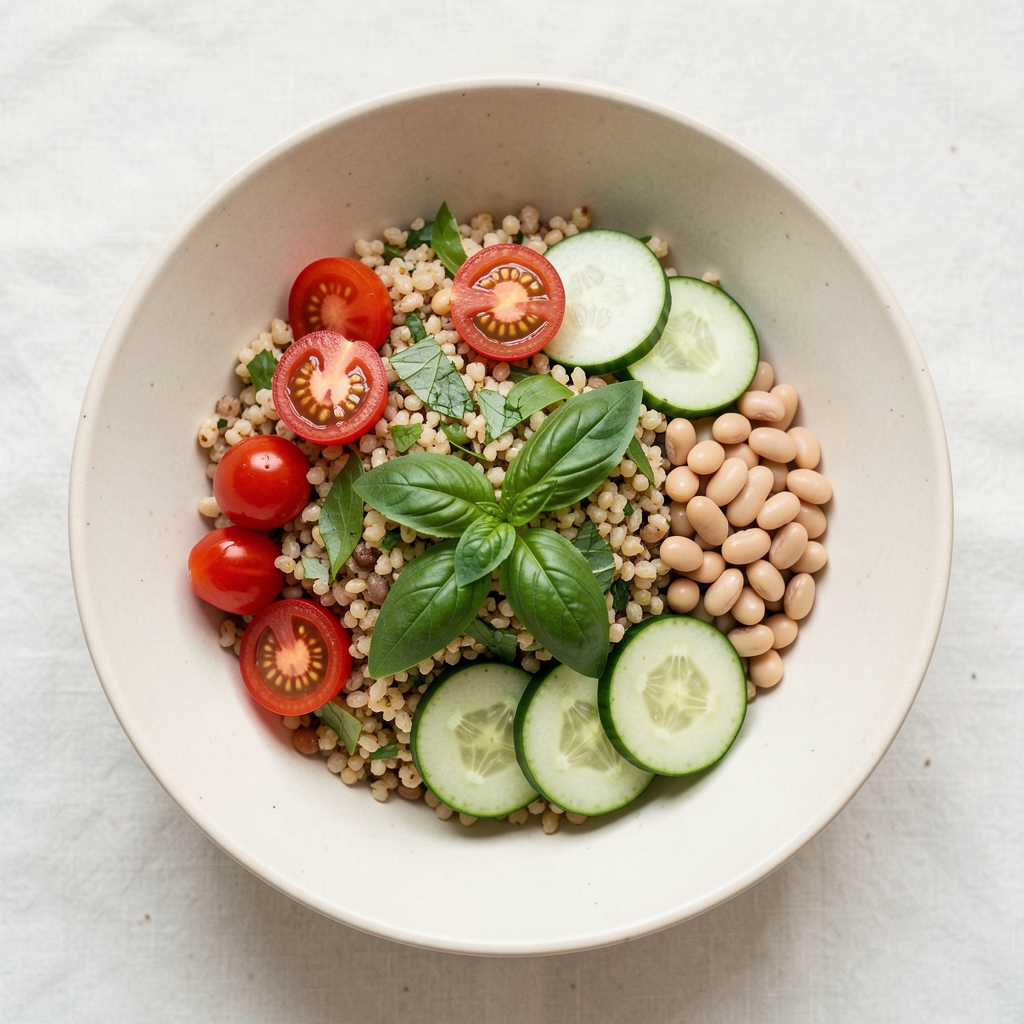
This seasonal lightening is not a deliberate dietary adjustment. It is a function of the available ingredients. A plate built around summer tomatoes, cucumber, and fresh herbs, served over a modest quantity of cooked grains or legumes, is structurally different from a winter plate of slow-roasted root vegetables and lentil stew — but both, in this documentation, represent a whole-food approach to a balanced meal. The seasonal transition simply produces a different expression of the same underlying principle: a predominantly plant-based composition, with whole grains in a supporting rather than dominant role, assembled from ingredients that are as close to their natural state as the available time and equipment allow.
The mid-year review of the notebook — conducted informally at the six-month mark — reveals a gradual drift in the grain-to-vegetable ratio. Without explicit management, the proportion of the plate occupied by vegetables has increased from approximately one-third in the first month to slightly under half in month six. The grain component has reduced correspondingly. This shift has not been the result of a decision. It has been the result of attention: the practice of recording, over weeks and months, what is on the plate creates a low-level awareness of the composition that appears, in this case, to have produced a slow and incremental adjustment.
Autumn and the Question of Appetite in Active Weeks
The third volume, covering the autumn months, introduces a variable that had been present but unrecorded in the earlier volumes: physical activity. The autumn entries begin to note, alongside the compositional record, whether a given day included significant movement — a long walk, a cycling commute, a period of sustained physical activity. The question being explored is not instructive; it is observational. Does a more active day correlate, in this notebook, with a measurably different appetite profile or compositional response?
The pattern that emerges across the autumn entries is consistent with the broader literature on sport, fitness, and nutritional intake: on active days, both the recorded appetite notes and the observed portion sizes suggest a higher energy requirement. The instinct toward larger grain and legume components is documented repeatedly in the autumn entries, without any prior instruction. The body's response to increased activity, in this record at least, is a natural adjustment toward more energy-dense whole foods — grains, root vegetables, legumes — rather than toward processed or refined alternatives.
This observation aligns with what qualified nutrition professionals in the field of sports and active lifestyle have noted for some time: that an attuned eating practice, conducted over sufficient months to have established a baseline awareness of appetite signals, tends to self-regulate toward appropriate intake on high-activity days without requiring explicit calculation. The notebook does not make this happen. It simply makes it visible.
The Year's End: What the Record Shows
The fourth volume closes in March of 2026, twelve months after the project began. Re-reading the four volumes in sequence produces a cumulative picture that would have been impossible to construct from memory. The dominant observations are these: vegetable diversity on the plate has increased across the year, gradually and without explicit management. Grain portions have reduced proportionally, settling at a level that the appetite notes consistently describe as satisfying. Legumes have moved from an occasional element to a near-daily feature of the evening meal, displacing a corresponding reduction in animal proteins. Gut-related comfort, recorded in the daily notes since month four, has been more consistently positive in the second half of the year than the first.
None of these observations constitutes a finding in the research sense. The sample size is one. The methodology is informal. The record-keeping, while sustained, is not rigorous by the standards of academic dietary documentation. What the notebook offers is not evidence but illustration: a detailed, first-person account of what a year of attentive, observation-based eating practice looks like when it is actually conducted, in a real kitchen, in the context of an ordinary London life.
The implications for a reader are modest and deliberate. The notebook approach may not suit every temperament. But the underlying principle — that sustained attention to what is actually eaten, recorded without judgment and revisited with curiosity, tends to support the gradual development of a more considered eating practice — is one that the accumulated documentation of this year-long project suggests is worth noting.
Field Notes — Key Observations
- — Baseline grain-to-vegetable ratios, recorded without prior adjustment, tend to favour grains. Observation alone, sustained over months, appears sufficient to produce a gradual rebalancing.
- — Seasonal produce transitions naturally shift meal composition without deliberate planning — winter favours density, summer favours diversity and lightness.
- — The appetite note "satisfied without fullness" correlates consistently with plates where vegetables constitute the dominant volume.
- — Active days generate a natural instinct toward more energy-dense whole foods — grains and legumes — rather than processed alternatives, in an established attentive eating practice.
- — Legumes, introduced gradually over the year, displaced a measurable proportion of animal protein in the recorded diet. Gut comfort notes improved in correspondence with this shift.
Articles published on Ibron Field Notes are editorial in nature and reflect the writers' observations on everyday wellness practices. The content is not intended as professional advice, nor as guidance for the management of any specific condition. Readers with specific concerns about their daily routines are encouraged to speak with a qualified wellness professional.